Bruno Guglielmina
The Eight Mountains: A NovelBruno Guglielmina is the youngest and, by his own account, the last boy growing up in the Grana mountain village. His friendship with the narrator begins in childhood, but his life is shaped just as strongly by the narrator’s mother, who takes an active interest in his education and makes him feel that his story matters. As an adult, he returns to the mountain life he knows, building a family and agricultural business there; their eventual collapse leaves him isolated and prompts the narrator’s mother to ask whether anyone can help him.
Identity and upbringing
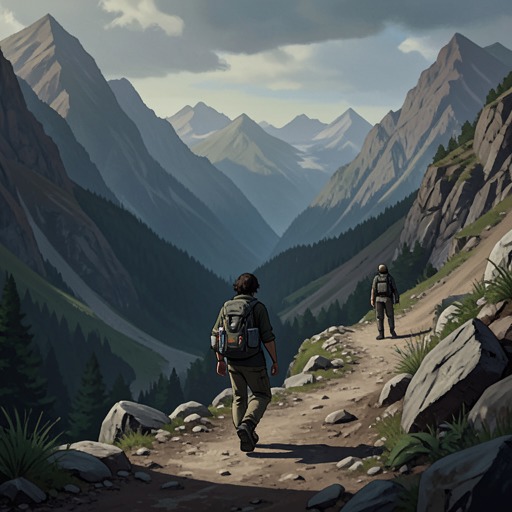
Born in November 1972, Bruno Guglielmina is only a few months older than the narrator. He tells the family that he is the youngest inhabitant of Grana mountain village and the last boy left there, with no prospect of other children following. The village’s dwindling population is not an abstraction for him: it describes the small world in which he grows up, where the school has little place in the lives of the remaining children and the surrounding landscape offers more immediate possibilities than formal study.
His household connects him to different forms of rural labor. His father, Luigi Guglielmina, spends much of the year away at construction sites in France or Switzerland, returning rarely and usually in winter. His mother stays in the village, tending a vegetable plot, a henhouse, two goats, and beehives. Bruno lives with her at an uncle’s house; the uncle owns pastures and dairy cows and spends time in the mountains with his older cousins. In August, Bruno is expected to join them with the younger cows left below. Herding and family work are therefore not an occasional escape from village life but part of the structure organizing it.
Friendship and education
The narrator’s mother first helps bring the boys together. Convinced that her son should make friends as well as spend time alone, she arranges for Bruno to come to their kitchen. He arrives for breakfast and explains that his surname is shared by many people in Grana, while his first name is unusual there. The boys had already watched one another from a distance in the pasture, each pretending not to notice the other. Their friendship soon takes on a daily rhythm: through the rest of that July, the narrator joins Bruno outside, or Bruno appears at the family’s home after stringing a wire around his cows and connecting it to a car battery.
The narrator’s mother becomes an important part of the friendship. She asks Bruno direct questions and listens as he tells the family about his life. He is proud that his experiences interest a woman from the city, and the narrator recognizes that the attention itself matters to him. The mother’s concern is consistent with her work as a health worker in Milan, where she supports families and assesses children’s circumstances. Her professional attention to children’s needs becomes a personal effort on Bruno’s behalf, though the effort also means intervening in decisions that belong to his family.
She understands that education cannot be secured by her efforts alone. After deciding that Bruno’s mother will not help, she focuses on his aunt, repeatedly visiting until the aunt agrees to send him to school during winter and to the family home for summer homework. Bruno comes three times a week, scrubbed and dressed for the lessons. The narrator’s mother has him read books by Stevenson, Verne, Twain, and Jack London, and lets him keep them to practice while he is up in the pastures. Bruno enjoys novels but struggles with grammar and spelling. The narrator feels uncomfortable watching him become entangled in rules that seem unfairly imposed, yet Bruno does not complain. He works hard, aware that the lessons matter to the woman who has made room for him in her life.
The proposed move and adult return
The family’s educational effort grows into an offer to take Bruno to Milan in September. The narrator’s parents propose housing him and enrolling him in a technical or professional institute, with a trial year: he could return to Grana the following summer if he disliked the arrangement, or stay through graduation if it worked. The offer is framed as a chance for Bruno to choose what to do with his life, but the narrator doubts that his uncle will agree. The evidence establishes the proposal and the narrator’s expectation, not its final outcome.
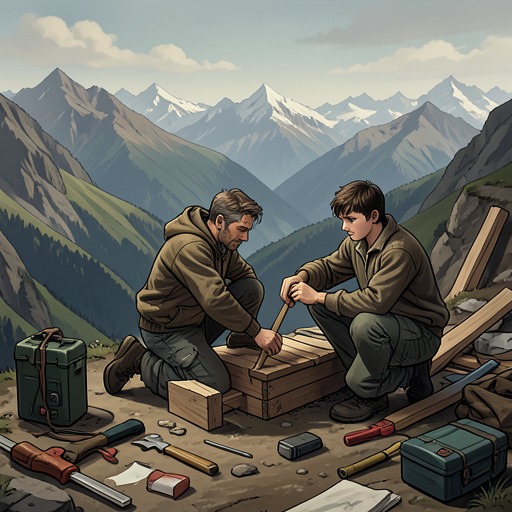
Years later, the narrator encounters a man he no longer recognizes easily, while still sensing the boy he had known in him. Bruno explains that the narrator’s father designed a house according to his own wishes and asked Bruno to build it. The father had made him promise to do so. Bruno is available to work, but the narrator has already used most of his inheritance to settle financial difficulties and does not have enough money to build. The exchange reveals a lasting connection between Bruno and the narrator’s father, as well as an unfulfilled plan entrusted to Bruno.
Family, work, and isolation
As an adult, Bruno has a daughter, Anita, and a partnership with Lara. The narrator’s mother remains a link between the two childhood friends, passing news to the narrator because the men themselves may go years without making contact. She becomes attached to Anita and sometimes keeps the child at Grana during the summer, giving Bruno and Lara relief from the demands of caring for her while they work. Her letters describe Anita growing up wild and fearless, but also convey her growing concern about the couple’s mounting strain.
The parents work increasingly hard, while Bruno withdraws into silence and work and Lara becomes exasperated by their debts. The narrator’s mother senses that the partnership is in crisis before the final news arrives. In autumn 2013, Bruno declares bankruptcy, closes the agricultural business, and hands the farm keys to the bailiff; Lara goes to live with her parents with Anita. The mother gives a different account of the order of events: in her version, Lara first decides to leave, and Bruno gives up afterward. The distinction does not alter the outcome, but it preserves the uncertainty surrounding a separation neither account can make simple. She tells the narrator that Bruno has lost everything and is alone, and asks whether anything can be done.
Narrative significance
Bruno’s life is repeatedly shaped by acts of care that come from outside the immediate household: the narrator’s mother’s visits, lessons, hospitality, and later care for Anita. Those efforts open possibilities, but they do not erase the material conditions of his upbringing or guarantee that he will remain connected to the people who help him. The early kitchen, where he is welcomed and listened to, stands in contrast to the later farm handed over to a bailiff and the silence into which he retreats. His story also complicates the idea that friendship must be maintained through constant contact. The narrator and Bruno can remain bound by a shared past even when they do not communicate, while the narrator’s mother supplies the practical attention that keeps their lives in view of one another.